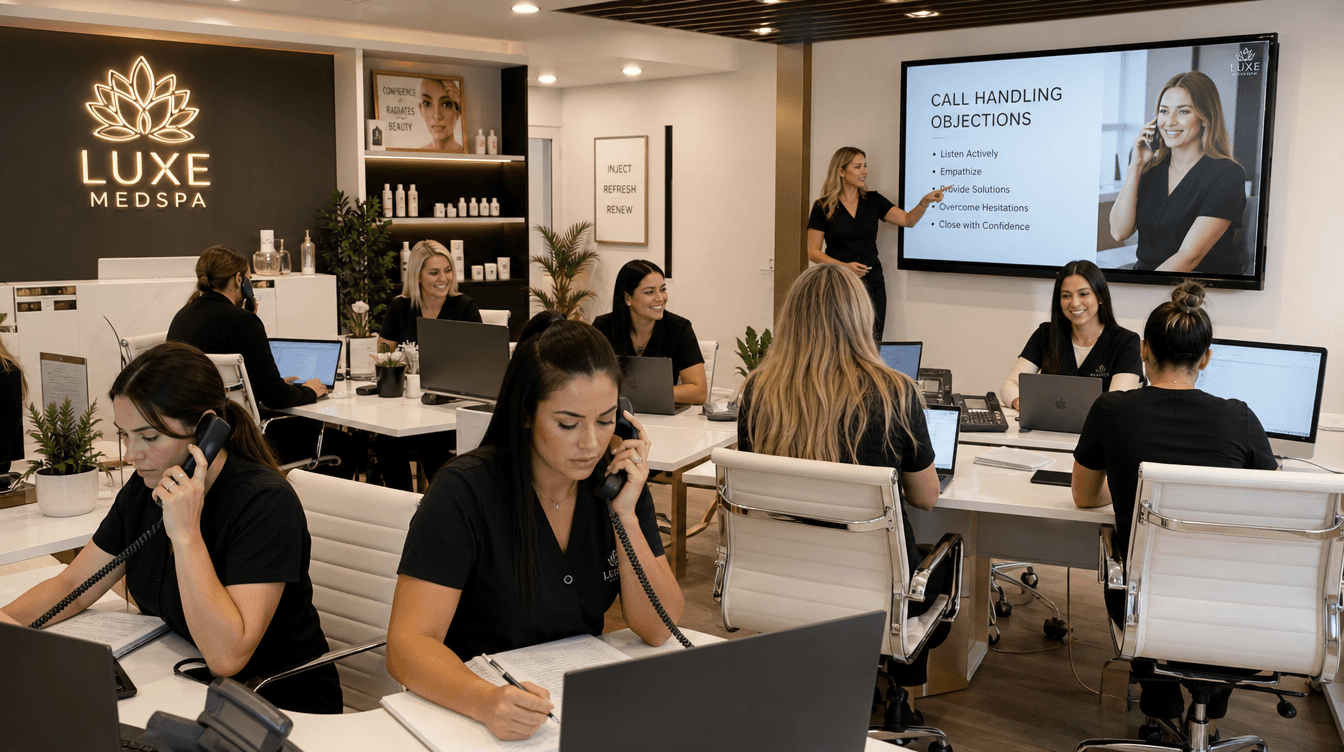
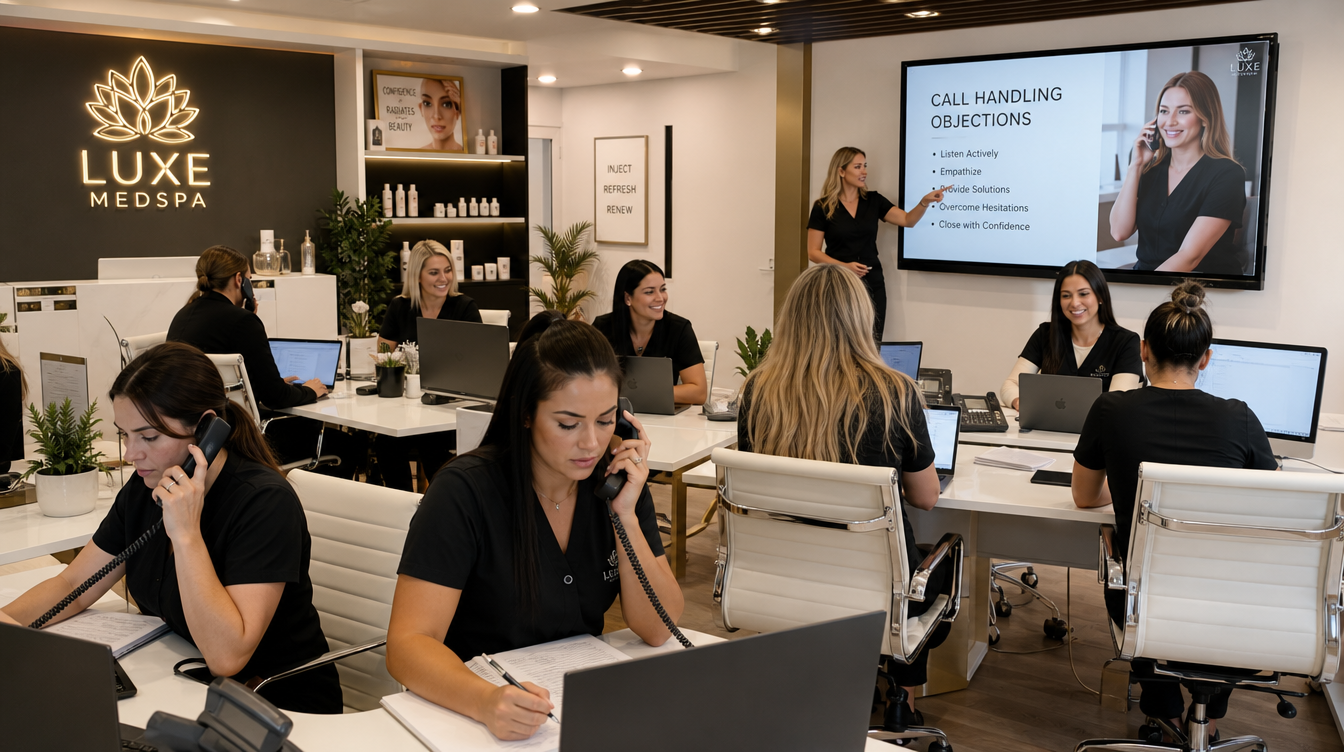
Introduction to Objection Handling in MedSpa Customer Service
Every inquiry that comes into a MedSpa represents a potential revenue opportunity. Whether a prospect calls about Botox, body contouring, laser treatments, or skin rejuvenation services, their decision to book often depends on the quality of the interaction they have with your team. This is why medspa customer service training plays such a critical role in business growth and profitability.
Many MedSpa owners invest heavily in marketing to generate leads, yet overlook the importance of training front-desk staff and patient coordinators to handle objections effectively. The result is a steady flow of interested prospects who never convert into consultations or treatment appointments.
Why Objection Handling Directly Impacts MedSpa Revenue
Objections are not necessarily signs that a prospect is uninterested. In most cases, they indicate that the individual needs additional information, reassurance, or confidence before making a decision.
When team members lack the skills to address concerns effectively, opportunities are often lost. Prospects may leave the conversation feeling uncertain, causing them to postpone treatment or seek services elsewhere.
On the other hand, a well-trained team can transform objections into productive conversations that build trust and increase booking rates. Even small improvements in consultation conversions can have a significant impact on monthly revenue and long-term patient value.
The Relationship Between Customer Trust and Treatment Bookings
Aesthetic treatments are highly personal decisions. Patients are often evaluating more than just pricing or scheduling—they are assessing whether they trust the provider, the facility, and the overall experience.
Trust is built through communication. The way staff members respond to questions and concerns can either strengthen confidence or create additional hesitation.
Prospects who feel heard and understood are far more likely to move forward with consultations and treatments. Effective objection handling helps create this sense of trust by demonstrating professionalism, expertise, and genuine concern for the patient’s goals.
Common Mistakes MedSpa Teams Make When Addressing Concerns
Many customer service representatives unintentionally create resistance when responding to objections.
One common mistake is rushing to provide answers before fully understanding the concern. Another is becoming defensive when prospects question pricing, treatment outcomes, or provider credentials.
Some team members focus exclusively on selling rather than listening. Others rely on generic responses that fail to address the specific needs of the individual.
Successful objection handling requires a more thoughtful approach—one that prioritizes understanding, empathy, and education before attempting to guide the prospect toward a decision.
Understanding the Psychology Behind MedSpa Objections
To improve conversion rates, MedSpa teams must first understand why objections occur. Most concerns are rooted in uncertainty rather than rejection.
When employees understand the psychology behind objections, they can approach conversations more effectively and create a better experience for prospective patients.
Why Prospects Hesitate Before Booking Treatments
Many patients spend weeks or even months researching treatments before contacting a MedSpa.
Their hesitation may stem from concerns about cost, safety, results, recovery time, provider expertise, or simply fear of making the wrong decision. For first-time patients, the uncertainty can be even greater.
Rather than viewing hesitation as a negative sign, customer service teams should recognize it as a natural part of the decision-making process.
The goal is not to eliminate concerns but to help prospects feel confident enough to move forward.
Emotional vs. Logical Buying Decisions in Aesthetic Services
Although patients often ask logical questions about pricing and treatment details, most aesthetic decisions are heavily influenced by emotions.
Patients may want to feel more confident, look younger, improve self-esteem, or address insecurities that have affected them for years. These emotional motivations often drive treatment decisions more than the technical features of a procedure.
Effective customer service training teaches employees how to address both logical and emotional factors. While providing accurate information is important, helping patients feel understood is often what ultimately influences their decision.
The Importance of Empathy in Customer Conversations
Empathy is one of the most valuable skills a MedSpa team can develop.
Patients want to know that their concerns are being taken seriously. When staff members demonstrate empathy, conversations become less transactional and more relationship-focused.
Simple statements such as “I understand why you would have that concern” or “Many of our patients initially felt the same way” can significantly reduce tension and build rapport.
Empathy creates a foundation of trust that makes it easier to address objections and guide patients toward the next step in their treatment journey.
Foundations of an Effective Objection Handling Training Program
Before teams can master objection handling, they need a structured training framework that supports consistent communication and service excellence.
A successful training program does more than teach scripts—it establishes standards that shape every patient interaction.
Defining Customer Service Standards for MedSpas
Customer service standards provide employees with a clear understanding of how they should communicate with patients.
These standards should define expectations related to professionalism, responsiveness, empathy, active listening, and patient education. When everyone follows the same service principles, the patient experience becomes more consistent and predictable.
Strong service standards also create accountability and help managers coach employees more effectively.
Establishing Consistent Communication Guidelines
Consistency is critical when handling objections.
Patients should receive the same level of professionalism and accurate information regardless of which team member answers the phone or responds to an inquiry.
Communication guidelines help ensure that responses remain aligned with the MedSpa’s brand, values, and treatment philosophy.
This consistency improves patient confidence while reducing confusion and misinformation.
Creating a Customer-Centered Service Culture
The most effective MedSpa teams focus on helping patients make informed decisions rather than simply closing sales.
A customer-centered culture encourages employees to prioritize patient needs, concerns, and goals during every interaction.
When staff members genuinely seek to help rather than persuade, objection handling becomes more natural and effective.
This approach often leads to stronger patient relationships, higher consultation conversion rates, and improved long-term loyalty.
The Core Objection Handling Script Framework
While every patient conversation is unique, successful objection handling typically follows a consistent structure. A repeatable framework gives employees confidence while ensuring prospects feel heard, respected, and supported throughout the conversation.
Step 1: Listen Without Interrupting
Allow the prospect to fully explain their concern before responding.
Interrupting can make patients feel dismissed and may prevent staff from understanding the true issue. Active listening demonstrates respect and creates a stronger foundation for productive dialogue.
Step 2: Acknowledge and Validate the Concern
After listening, acknowledge the concern sincerely.
For example:
“I completely understand why you’d want to learn more about that before making a decision.”
Validation does not mean agreeing with the objection—it means recognizing that the concern is reasonable from the patient’s perspective.
Step 3: Clarify the Root Cause of the Objection
Many objections are symptoms of deeper concerns.
Ask thoughtful questions to uncover the real issue.
Examples include:
“Can you tell me more about what specifically concerns you?”
or
“Is your primary concern the investment, the treatment itself, or the timing?”
Clarification prevents staff from addressing the wrong problem.
Step 4: Provide Relevant Information and Solutions
Once the concern is understood, offer information that directly addresses the patient’s needs.
Focus on education rather than pressure. Provide clear explanations, share relevant treatment information, and offer appropriate solutions that align with the patient’s goals.
Step 5: Confirm Understanding and Gain Agreement
Before moving forward, ensure the patient feels their concern has been addressed.
A simple question such as:
“Does that help answer your question?”
creates an opportunity to confirm understanding and identify any remaining concerns.
Step 6: Guide the Customer Toward the Next Action
The final step is helping the prospect take the next logical action.
This may involve scheduling a consultation, booking a treatment, speaking with a provider, or receiving additional educational resources.
A confident yet supportive transition keeps momentum moving forward while respecting the patient’s decision-making process.
By consistently following this framework, MedSpa teams can handle objections more effectively, improve conversion rates, and create a more positive experience for prospective patients.
Essential Components Every MedSpa Script Must Include
An objection-handling script is only effective if it helps staff build trust, gather information, and guide prospects toward a decision without sounding robotic or overly sales-focused. The best scripts provide structure while still allowing conversations to feel natural and personalized.
A strong script should include several key elements that support rapport-building, active listening, confidence creation, and appointment conversion.
Opening Statements That Build Rapport
The first few moments of a conversation often determine how comfortable a prospect feels.
Effective opening statements should be warm, welcoming, and patient-focused rather than transactional. Instead of immediately discussing treatments or pricing, staff should focus on building a connection.
For example:
“Thank you for reaching out today. I’d love to learn a little more about what you’re hoping to achieve so we can point you in the right direction.”
This approach shifts the conversation toward the patient’s goals and creates a more engaging experience.
Active Listening Phrases for Better Engagement
Patients want to feel heard.
Active listening phrases demonstrate attentiveness and encourage prospects to share more information about their concerns.
Examples include:
- “That’s a great question.”
- “I can understand why you’d want clarification on that.”
- “Tell me a little more about what you’re looking for.”
- “I appreciate you sharing that with me.”
These statements help strengthen rapport while creating opportunities to uncover the real reasons behind objections.
Confidence-Building Responses
Patients often seek reassurance before making a decision.
Confidence-building responses should focus on education, expertise, and patient outcomes without making unrealistic promises.
Examples include:
- “Many of our patients initially had similar questions before their consultation.”
- “Our providers take the time to develop a personalized treatment plan based on your goals.”
- “We’ll make sure you fully understand your options before making any decisions.”
These responses help reduce uncertainty while reinforcing trust.
Transition Statements That Maintain Momentum
One of the biggest mistakes customer service teams make is allowing conversations to stall after addressing an objection.
Transition statements help keep discussions moving forward.
Examples include:
- “Now that we’ve addressed that concern, let’s talk about what you’re hoping to accomplish.”
- “Based on what you’ve shared, I think a consultation would be the best next step.”
- “Let me explain how our process works so you know exactly what to expect.”
These statements maintain momentum and prevent conversations from losing direction.
Appointment-Closing Language
The goal of most inquiry calls is to secure the next step in the patient journey.
Effective closing language should feel consultative rather than aggressive.
Examples include:
- “Would you like me to help you schedule a consultation so we can answer your questions in more detail?”
- “We have availability this week. Which day works best for you?”
- “Let’s reserve a time so you can meet with one of our specialists and explore your options.”
Simple, confident closing statements often outperform high-pressure sales tactics.
Handling Price Objections Effectively
Price objections are among the most common challenges faced by MedSpa customer service teams. However, cost concerns are not always about affordability. In many cases, patients are evaluating whether the perceived value justifies the investment.
Understanding this distinction is essential for improving conversion rates and strengthening patient trust.
Understanding the True Meaning Behind Cost Concerns
When a prospect says, “It’s too expensive,” they may actually mean several different things:
- They do not fully understand the treatment benefits.
- They are comparing multiple providers.
- They are unsure whether results will justify the investment.
- They need additional time to make a decision.
- They are concerned about budgeting.
The objective is not to overcome the objection immediately but to understand the underlying concern.
By asking thoughtful questions, staff can identify the real issue and provide more relevant information.
Sample Script for “It’s Too Expensive”
A common mistake is responding defensively or immediately offering discounts.
Instead, consider a structured response:
Patient: “That sounds expensive.”
Staff Member: “I completely understand. Many patients want to make sure they’re investing in the right treatment for their goals. May I ask what specifically concerns you about the pricing?”
Patient: “I’m not sure it’s worth it.”
Staff Member: “That’s understandable. Our consultation process is designed to help determine whether the treatment is truly the right fit for you. During that appointment, we’ll discuss expected results, alternatives, and a personalized plan so you can make an informed decision.”
This approach keeps the conversation focused on value rather than price alone.
Demonstrating Value Without Discounting
Many MedSpas immediately resort to discounts when price objections arise.
While promotions can be useful strategically, excessive discounting can reduce perceived value and weaken profitability.
Instead, customer service teams should emphasize:
- Provider expertise
- Personalized treatment planning
- Safety standards
- Patient experience
- Long-term outcomes
When patients understand the benefits they are receiving, they are often more willing to invest.
This approach also supports efforts related to how to improve medspa patient retention, as patients who choose providers based on trust and value tend to remain loyal longer than those motivated solely by discounts.
Discussing Financing and Payment Options Professionally
Financing can help make treatments more accessible without reducing perceived value.
When discussing payment options, staff should present them as convenience tools rather than indicators of affordability concerns.
For example:
“Many of our patients choose financing because it allows them to begin treatment while spreading payments over time. I’d be happy to explain the options available.”
This keeps the conversation professional and solution-oriented.
Addressing Fear and Anxiety About Treatments
Fear is another common reason prospects hesitate to book consultations or treatments.
Many patients worry about pain, side effects, recovery time, or whether they will achieve the results they desire.
Customer service teams who understand these concerns can provide reassurance without creating unrealistic expectations.
Identifying Common Patient Fears
Common concerns often include:
- Fear of looking unnatural
- Fear of pain or discomfort
- Fear of complications
- Fear of wasting money
- Fear of making the wrong decision
Recognizing these concerns allows staff to respond more effectively and empathetically.
Sample Script for Nervous or First-Time Clients
Patient: “I’ve never had anything like this done before, and I’m nervous.”
Staff Member: “That’s completely normal. Many of our patients felt the same way before their first consultation. Our providers take time to answer questions, explain the process thoroughly, and make sure you feel comfortable before moving forward with any treatment.”
Patient: “That makes me feel a little better.”
Staff Member: “I’m glad to hear that. Our goal is to help you make the decision that’s right for you, and we’re here to guide you through every step of the process.”
This type of response reduces anxiety while strengthening trust.
Reassurance Techniques That Build Confidence
Effective reassurance includes:
- Acknowledging concerns
- Providing clear information
- Explaining the consultation process
- Highlighting patient education
- Emphasizing personalized care
The objective is not to pressure patients into booking but to help them feel informed and supported.
When patients feel safe and respected, they are more likely to move forward confidently.
Role-Playing and Practice Exercises
Even the best objection-handling scripts require practice.
Knowledge alone does not improve performance. Teams must actively rehearse conversations so responses become natural and confident during real patient interactions.
Regular role-playing sessions are one of the most effective components of any medspa customer service training program.
Designing Effective Objection Handling Scenarios
Training scenarios should reflect common real-world situations.
Examples include:
- Price objections
- Scheduling concerns
- Treatment anxiety
- Comparison shopping
- Requests for discounts
- Questions about provider qualifications
Practicing realistic situations helps employees develop confidence and adaptability.
Group Training Activities for Customer Service Teams
Group exercises encourage collaboration and peer learning.
Managers can assign employees different roles, including patient, coordinator, and observer. After each exercise, the group can discuss strengths, opportunities for improvement, and alternative responses.
These sessions often reveal valuable coaching opportunities while helping team members learn from one another.
Measuring Performance During Simulations
Role-playing should include measurable performance criteria.
Managers can evaluate:
- Listening skills
- Empathy
- Questioning techniques
- Objection resolution effectiveness
- Confidence
- Appointment-closing ability
Tracking these skills over time helps organizations identify training needs and monitor progress.
Some MedSpas also leverage a virtual assistant for medical spa operations to support lead follow-up and appointment coordination, allowing front-desk teams to spend more time refining high-value communication skills such as objection handling and patient relationship building.
Creating Customized Scripts for Different Communication Channels
Modern MedSpa prospects interact with businesses through multiple communication channels before making a booking decision. Some prefer phone calls, while others rely on text messaging, email, website chat, or social media direct messages.
Because each channel has unique characteristics, customer service teams should avoid using a one-size-fits-all approach. Instead, objection-handling scripts should be customized to fit the communication style, response expectations, and engagement patterns associated with each platform.
A channel-specific strategy helps create a more seamless customer experience while improving consultation conversion rates.
Phone Call Objection Handling Scripts
Phone conversations provide the greatest opportunity to build rapport and address concerns in real time.
Because staff can hear tone, emotion, and hesitation, phone scripts should focus heavily on active listening and personalized responses.
For example, when addressing a pricing objection:
“I completely understand wanting to make sure you’re making the right investment. Can I ask what specifically concerns you about the pricing so I can better assist you?”
This type of response encourages dialogue rather than ending the conversation.
Phone scripts should also include:
- Discovery questions
- Empathy statements
- Value-focused explanations
- Clear appointment-closing language
The objective is to create a comfortable conversation that guides the prospect toward the next step.
Text Message Response Frameworks
Text messaging requires a different approach.
Messages should be concise, conversational, and easy to understand. Long explanations can overwhelm prospects and reduce engagement.
A simple framework works best:
Acknowledge → Clarify → Guide
Example:
“Thanks for reaching out. I completely understand your concern about treatment costs. May I ask which treatment you’re interested in so I can provide the most accurate information?”
Once clarification is received, staff can guide the conversation toward a consultation or appointment.
Text messaging is particularly effective for appointment confirmations, follow-up communication, and re-engaging leads who may not respond to phone calls.
Email-Based Objection Handling Templates
Email allows teams to provide more detailed information while maintaining a professional tone.
Templates should include:
- Personalized greetings
- Acknowledgment of concerns
- Educational content
- Clear next steps
For example:
“Thank you for contacting us regarding laser treatments. We understand that many patients have questions before scheduling a consultation. Our providers take time to evaluate your goals and create a personalized treatment plan designed specifically for your needs.”
Well-crafted email templates help ensure consistency while allowing staff to personalize responses when appropriate.
Live Chat and Social Media Inquiry Responses
Website chat and social media messaging often involve prospects who are still in the research phase.
These conversations typically move quickly and require immediate engagement.
Responses should:
- Be friendly and conversational
- Address concerns efficiently
- Encourage continued dialogue
- Guide prospects toward consultations
For example:
“That’s a great question. Many first-time patients ask the same thing. I’d be happy to explain the process and help you determine whether this treatment is a good fit for your goals.”
The goal is not necessarily to close the appointment immediately but to keep the conversation moving forward and build interest.
Metrics for Evaluating Objection Handling Success
Training programs should be measured by outcomes rather than activity alone.
Many MedSpas invest time in customer service training but fail to track whether those efforts actually improve performance. Establishing clear metrics helps leadership evaluate effectiveness and identify opportunities for improvement.
Data-driven measurement also allows organizations to refine scripts and coaching strategies over time.
Consultation Booking Conversion Rates
One of the most important metrics is consultation conversion rate.
This measures how many inquiries ultimately result in booked consultations.
If objection-handling skills improve, conversion rates should increase because staff become more effective at addressing concerns and guiding prospects toward appointments.
Tracking conversion rates by employee, communication channel, and treatment category can provide valuable insights into performance trends.
Appointment Retention Metrics
Booking appointments is important, but keeping those appointments is equally valuable.
Appointment retention metrics help organizations understand whether prospects remain committed after scheduling.
High cancellation or no-show rates may indicate unresolved concerns that were not fully addressed during the initial conversation.
Monitoring these metrics helps identify opportunities to improve communication and strengthen patient confidence.
Customer Satisfaction and Feedback Scores
Patient feedback provides valuable information about customer service performance.
Surveys, reviews, and satisfaction scores can reveal how patients perceive communication quality, professionalism, responsiveness, and overall experience.
Strong satisfaction scores often correlate with effective objection handling because patients feel heard, respected, and supported throughout the decision-making process.
Staff Confidence and Performance Assessments
Training success should also be evaluated internally.
Managers can assess:
- Communication skills
- Objection-handling effectiveness
- Appointment-closing ability
- Empathy and active listening
- Compliance with service standards
Regular evaluations help identify coaching opportunities and ensure skills continue improving over time.
Building a Comprehensive Objection Handling Playbook
While scripts are valuable tools, the most successful MedSpas go beyond individual responses and create comprehensive objection-handling playbooks.
A playbook serves as a centralized resource that helps teams maintain consistency, improve training outcomes, and scale customer service excellence across the organization.
Organizing Scripts by Objection Category
Not all objections are the same.
Organizing responses by category makes it easier for employees to locate and apply the appropriate guidance.
Common categories include:
- Pricing concerns
- Treatment anxiety
- Scheduling conflicts
- Provider qualifications
- Recovery questions
- Results expectations
- Comparison shopping
This structure allows employees to prepare for a wide variety of scenarios while maintaining consistency.
Developing Quick-Reference Guides for Staff
Front-desk professionals often need immediate access to information during conversations.
Quick-reference guides help employees respond confidently without searching through lengthy manuals.
These guides may include:
- Common objection examples
- Recommended responses
- Key talking points
- Appointment-closing phrases
- Escalation procedures
Easy access to information improves both speed and consistency.
Creating Standard Operating Procedures
Objection handling should become part of everyday operations rather than an isolated training topic.
Standard Operating Procedures (SOPs) ensure every employee follows the same process when responding to concerns.
These procedures should define:
- Communication expectations
- Escalation protocols
- Documentation requirements
- Follow-up procedures
- Performance standards
A well-documented system creates a stronger customer experience while supporting ongoing team development.
Future Trends in MedSpa Customer Service Training
Customer expectations continue to evolve, and MedSpa training programs must evolve with them.
Organizations that embrace new technologies and data-driven strategies will be better positioned to improve conversion rates, strengthen patient relationships, and remain competitive in an increasingly crowded marketplace.
AI-Assisted Customer Communication
Artificial intelligence is becoming an increasingly valuable tool for customer engagement.
AI-powered systems can help answer common questions, qualify leads, schedule appointments, and support follow-up communication.
Rather than replacing human interaction, these tools help teams focus on high-value conversations that require empathy and relationship-building skills.
Many organizations are also integrating a virtual assistant for medical spa operations to manage routine inquiries and ensure faster response times.
Personalized Customer Journey Mapping
Patients increasingly expect personalized experiences.
Future training programs will place greater emphasis on understanding where prospects are within the customer journey and adapting communication accordingly.
A first-time Botox prospect may require different messaging than a long-term patient considering advanced treatments.
Personalized communication helps strengthen trust and improve conversion opportunities.
Data-Driven Script Refinement
The most effective scripts will continue evolving based on performance data.
Organizations can analyze:
- Conversion rates
- Appointment outcomes
- Patient feedback
- Call recordings
- Inquiry trends
These insights allow teams to continuously refine messaging and improve effectiveness.
This data-driven approach also supports broader initiatives focused on how to improve medspa patient retention, as stronger communication often leads to better patient experiences, increased loyalty, and more repeat bookings.
As MedSpas continue adopting technology and analytics, objection handling will become more precise, measurable, and impactful than ever before.
Conclusion
Effective objection handling is one of the most valuable skills a MedSpa team can develop. While marketing generates inquiries and consultations create opportunities, it is often the quality of customer conversations that determines whether a prospect becomes a patient.
A well-structured objection handling process helps teams build trust, address concerns confidently, and guide prospective patients toward informed decisions. More importantly, it creates a customer experience that feels supportive rather than sales-driven.
Key Takeaways for Effective MedSpa Objection Handling
The most successful MedSpa teams recognize that objections are not barriers—they are opportunities.
When patients raise concerns about pricing, safety, timing, provider qualifications, or treatment outcomes, they are typically seeking reassurance and clarity rather than rejecting the service outright.
Effective objection handling requires:
- Active listening before responding
- Empathy and validation
- Thoughtful questions to uncover the real concern
- Clear and educational responses
- Confidence-building communication
- A structured path toward the next action
By following a consistent framework, customer service teams can improve both patient experiences and consultation conversion rates.
The Long-Term Impact of Strong Customer Service Scripts
Strong customer service scripts do more than help staff respond to objections. They create consistency across the organization and establish a higher standard of communication.
When employees receive ongoing medspa customer service training and follow proven objection-handling frameworks, organizations often experience:
- Increased consultation bookings
- Higher appointment retention rates
- Improved patient satisfaction
- Better team confidence
- Stronger brand reputation
- Increased patient loyalty
These improvements can significantly influence long-term business growth and operational performance.
Additionally, organizations seeking answers to how to improve medspa patient retention often discover that effective communication is one of the most powerful retention tools available. Patients who feel informed, understood, and supported are more likely to remain loyal and continue their treatment journey with the practice.
Action Steps for Building a High-Converting Training Program
Creating a high-performing objection handling program does not require complicated systems.
MedSpa leaders can begin by:
- Documenting common objections encountered by staff.
- Creating standardized response frameworks.
- Conducting regular role-playing exercises.
- Tracking conversion and satisfaction metrics.
- Reviewing call recordings and customer interactions.
- Updating scripts based on performance data and patient feedback.
- Providing ongoing coaching and reinforcement.
When objection handling becomes a core component of customer service training, teams gain confidence, patients feel more comfortable, and conversion opportunities increase.
The result is a more predictable, scalable, and profitable MedSpa operation.
Frequently Asked Questions (FAQs)
1. Why is objection handling important in a MedSpa environment?
Objection handling helps staff address patient concerns regarding treatments, pricing, safety, timing, and results. Effective responses build trust, improve consultation conversion rates, and create a more positive patient experience.
2. What are the most common objections MedSpa customers raise?
Common objections include treatment cost, fear of discomfort, concerns about safety, uncertainty about results, scheduling conflicts, provider qualifications, and hesitation about committing to treatment plans.
3. How can staff discuss pricing without sounding sales-oriented?
The focus should remain on education and value rather than persuasion. Staff should seek to understand the patient’s concerns, explain the benefits of treatment, and discuss available options without applying pressure.
4. What should a customer service representative say when a client is nervous about treatment safety?
A representative can acknowledge the concern and provide reassurance by explaining the provider’s qualifications, consultation process, safety protocols, and commitment to patient education.
For example:
“It’s completely normal to have questions about safety. Our providers take time to review your concerns, explain the treatment process, and ensure you’re comfortable before making any decisions.”
5. How often should MedSpa objection handling scripts be updated?
Scripts should be reviewed regularly and updated whenever treatment offerings, patient concerns, regulations, or performance data indicate improvements are needed. Many organizations review scripts quarterly or semi-annually.
6. Should customer service teams memorize scripts word-for-word?
No. Scripts should serve as structured guides rather than rigid conversations. Employees should understand the principles behind the script and adapt responses naturally to each patient’s situation.
7. What metrics should MedSpas track to measure objection handling effectiveness?
Key performance indicators include:
- Consultation conversion rates
- Appointment retention rates
- No-show rates
- Customer satisfaction scores
- Review ratings
- Lead response times
- Staff performance evaluations
These metrics provide valuable insight into training effectiveness.
8. How can role-playing improve customer service performance?
Role-playing helps employees practice responses in a safe environment before interacting with actual patients. It builds confidence, strengthens communication skills, and helps teams prepare for common objections and challenging scenarios.
9. What compliance risks should MedSpas consider when discussing treatment results?
Teams should avoid making guarantees regarding outcomes, overstating benefits, or providing misleading information. Communications should remain accurate, transparent, and aligned with provider-approved messaging and applicable regulations.
10. How can MedSpas maintain consistency in objection handling across multiple locations?
Consistency can be achieved through standardized scripts, documented procedures, centralized training programs, regular coaching, performance monitoring, and shared customer service standards across all locations.
How Can V-Assist Help You With Effective MedSpa Objection Handling?
Building a high-performing customer service team requires more than occasional coaching sessions and basic scripts. Today’s MedSpa organizations need structured systems that help staff respond confidently, consistently, and professionally across every patient interaction.
V-Assist helps MedSpas strengthen customer service performance through specialized support solutions designed for the unique needs of aesthetic practices. Whether your team struggles with consultation conversions, appointment booking rates, follow-up consistency, or patient communication, V-Assist provides the operational support needed to improve outcomes.
From front-desk communication workflows to lead management processes and customer service best practices, V-Assist helps create a more streamlined and scalable approach to patient engagement.
Many MedSpas also leverage a virtual assistant for medical spa support to manage inquiries, assist with lead follow-up, coordinate appointments, and ensure prospects receive timely responses—allowing in-house teams to focus on delivering exceptional patient experiences.
Ready to Improve Consultation Conversions and Patient Retention?
If you’re looking to strengthen your customer service processes, improve objection handling performance, and create more consistent patient experiences, V-Assist can help.
Schedule a consultation today to learn how V-Assist can support your MedSpa with proven communication systems, customer service workflows, and virtual support solutions designed to increase bookings, improve retention, and drive long-term growth.